2026 NUCA Chairman: David Howell
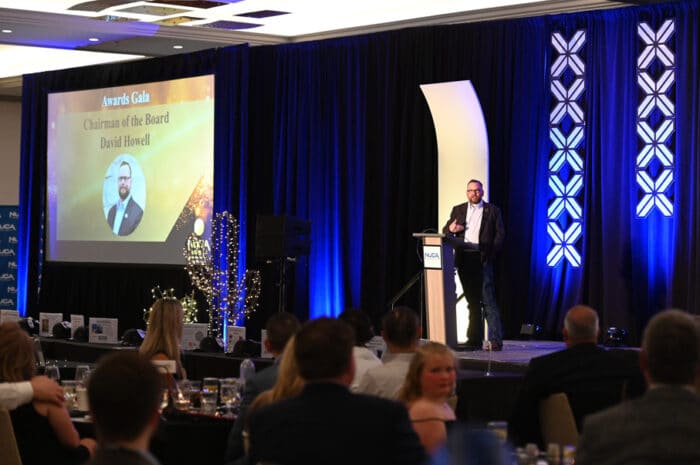
Born and raised in central Indiana, David Howell has spent his life close to the ground he now helps utility contractors work beneath every day. His family has been rooted in the Indianapolis area since the 19th century, and that sense of place and continuity runs through his career and his philosophy about the underground construction business. Today, as a senior leader at Midwest Mole and the incoming chairman of the National Utility Contractors Association (NUCA), Howell is focused on using that experience to strengthen both his company and the broader utility construction industry.
Early roots and a path into utilities
Howell’s path into construction started with an interest in engineering, tempered by the honest realization that he “didn’t really want to do all the math.” After a brief stop in business studies, he shifted into civil engineering technology and construction management at Purdue University in Indianapolis, a move that put him on a more practical, field-oriented trajectory.
His first construction job was with his great-uncle’s company, a commercial builder specializing in pre‑engineered steel structures where he spent a summer as a laborer. That initial taste of building work soon gave way to the utility side, as he joined Commonwealth Engineers as a CAD technician and field inspector, gaining exposure to water and sewer projects and the day‑to‑day realities of infrastructure work. Influenced by his stepfather’s view that utilities offered one of the safest, most stable sectors — “people always need water and they always need to flush the toilet” — Howell began to see underground utilities as both a secure and genuinely interesting career path.
Even as a kid, the work under the street captured his imagination. He recalls watching a pipeline project near his home and then recreating it in a backyard sandbox, digging small trenches and laying “pipes” made of twigs. That early fascination with what happens out of sight would eventually shape his entire professional life.
Growing with Midwest Mole
In 2004, Howell made the move that would define his career, joining Midwest Mole. At the time, the company was about 22 years old and transitioning to second‑generation leadership under Dan Liotti, who had recently taken over from his father, Len. Howell came in as a field engineer, drawing on his survey and inspection background, and quickly became a utility player inside the firm.
Over the years, he has held roles as project engineer, estimator, project manager, and even safety director, often stepping into whatever opportunity presented itself. As Midwest Mole grew — moving from its original Quonset‑hut‑and‑trailer setup into a more modern facility
— the company’s evolution paralleled Howell’s own development as a tunneling and trenchless professional. He points to the firm’s expansion from a regional contractor into a national name in trenchless work as a point of pride, noting how different the last 22 years of growth have been from the first 22.
Midwest Mole’s transition to an employee stock ownership plan (ESOP) in 2020 opened the door to a more diversified business structure and a broader leadership role for Howell. The company created MWM Holdings, adding additional business lines from a environmental engineering business focused on the freight rail industry and a rail construction business.
Today, Howell spends his time across all three entities. He continues to lead business development for Midwest Mole, leveraging his industry relationships and NUCA involvement to help identify opportunities and maintain the company’s reputation in trenchless and utility work. With their rail construction business, his focus is on instilling the “Midwest Mole way” in a newer team and ensuring the culture and standards of Midwest Mole carry over. In the engineering business, he works alongside co‑leader Lance Rasnake to guide the firm’s growth and integrate its expertise into field operations.
That cross‑company role keeps his days varied: one moment he might be in a meeting about safety and environmental requirements on a D.C. project, the next he’s helping rail crews navigate utility interface issues. He characterizes the MWM group as “one big family,” with different personalities across the businesses but a shared mission to solve challenging problems.
Career highlights and industry change
Looking back, Howell points to several projects that shaped his career and deepened his interest in rail and trenchless work. One standout was a massive project in Arizona, where Midwest Mole teamed with Iowa Trenchless and Pacific Boring to install 525 auger bores along roughly 103 miles of new double track in an intense schedule spanning about a year. Serving as project manager across all three companies, he saw firsthand how collaboration and logistics drive success on large‑scale rail jobs.
NUCA also opened the door to key opportunities, including a high‑profile sewer project along Washington, D.C.’s Rock Creek Parkway that grew out of a convention contact in Phoenix. From emergency sewer collapse repairs just blocks from the White House to rehabilitation work in older systems like those in Ohio, Howell has developed a deep appreciation for the craftsmanship of early 20th‑century builders and the complexity of modern rehabilitation.
He’s watched the industry shift from paper timesheets and faxed reports to a fully digital environment, where photos, models, and even virtual reality can be used to explain jobsite realities. At the same time, he believes safety culture and training have dramatically improved over the last two decades, even as the proliferation of methods and products has made it harder for owners and engineers to fully grasp the nuances of underground work. That gap, he says, underscores the need for better education and more time in the field for designers and inspectors.
Deep engagement with NUCA
Howell’s NUCA story began with Washington Summit visits tied to Indiana’s NUCA chapter, and then the pivotal 2008 NUCA convention where Midwest Mole’s booth led directly to the Rock Creek project in D.C. The clear business value of that single opportunity convinced the company to invest more deeply in the association. Midwest Mole went on to become a founding member of NUCA of DC and NUCA of Kentucky, and is also active in NUCA of Indiana and NUCA of Ohio.
Over time, Howell moved from chapter involvement into national leadership. After serving as a regional vice chair for the central region, he joined NUCA’s executive committee, starting as secretary and progressing through the leadership track toward the chairmanship. Throughout, he has remained closely involved with NUCA’s Trenchless Committee, helping strengthen cooperation between NUCA and NASTT, including a memorandum of understanding to coordinate efforts and avoid duplicative technical publications.
His NUCA work extends far beyond trenchless. He’s active in related organizations like ASCE, where he chairs the committee updating the Horizontal Auger Boring Manual of Practice 106, and AREMA, where he serves on the subcommittee dealing with utilities crossing railroads. In Howell’s view, having NUCA members at those tables ensures that utility contractors’ perspectives are represented when best practices and guidelines are written.
Vision as incoming NUCA chairman
As he steps into the NUCA chairmanship, Howell is focused on refining how the association serves contractors and strengthening the industry’s future workforce. NUCA is in the process of reassessing its structure and purpose, and Howell sees an ongoing need to streamline and modernize the association so chapters and members clearly see national‑level value, particularly as industry participation in trade groups has become more selective.
Workforce development stands at the top of the agenda. Howell wants to expand NUCA’s “Dozer Days” and similar outreach efforts, not only to attract field staff, but also to reach the next generation of engineers and construction managers. To change that, he envisions NUCA student chapters at universities, modeled on groups like ASCE and AGC student chapters, giving undergraduates direct exposure to utility construction and contractor perspectives.
“When I was in college, all the engineering and construction management students wanted to build buildings or bridges – nobody wanted to put pipes in the ground that nobody is ever going to see,” he says. “But as we see in the industry, once people develop an interest in underground construction, they tend to stay in the business for a long time.”
Beyond recruitment, Howell believes NUCA can help young engineers better understand constructability, risk, and the realities of building underground — knowledge that is often missing when textbooks and classroom theory dominate. By giving students a window into trenchless and tunneling — whether through site visits, VR, or contractor‑led sessions — NUCA can help reduce the disconnect between design and construction that he still sees on many projects.
Howell sees a continuing need to strengthen NUCA’s advocacy role. The association’s core mission, as he sees it, is to be a unified voice for utility contractors in legislative and regulatory arenas, from funding debates to OSHA and Corps of Engineers rulemaking. In a landscape marked by consolidation and shifting priorities, Howell believes NUCA’s broad utility focus — serving water, sewer, electric, and telecom contractors alike — makes it uniquely positioned to speak for the entire underground infrastructure community.
“We’re stronger together than anything,” he says, emphasizing that only by standing together can contractors influence policies that foster growth. As chairman, he aims to keep that message front and center while pushing NUCA to innovate in how it engages members, educates future professionals, and champions the value of utility construction.
NUCA Chairs