Getting Paid on Federal Projects: How Subcontractors Can Obtain Payment Bond Information
For subcontractors and suppliers working on federal construction projects, one of the most frustrating hurdles to getting paid is not having access to the payment bond. You’ve done the work, delivered the materials, and now the general contractor refuses to provide you with a copy of the payment bond.
This problem is more common than it should be. Although the Miller Act guarantees your right to make a claim against the payment bond, your ability to do so hinges on having a copy of that bond.
Why the Bond Matters
Under the Miller Act (40 U.S.C. §§ 3131–3134), prime contractors on federal projects over $100,000 are required to post a payment bond to ensure that subcontractors and suppliers are paid. If the prime contractor fails to pay, the bond claim is likely your best legal recourse. But it’s axiomatic that you can’t make a claim if you don’t know who issued the bond or how to contact the surety. In a well-functioning relationship, the general contractor will provide the bond upon request. But when tensions rise or payments are delayed, some prime contractors refuse to share the payment bond, hoping to delay or discourage claims.
Pro tip: Ask for a copy of the bond at the beginning of the project. It’s much easier to get cooperation when everyone’s still smiling and believing the project will come in early and under budget.
Fortunately, if the prime contractor refuses to provide a copy of the payment bond, federal law is on your side. Thanks to a recent amendment to the Federal Acquisition Regulation, effective Aug. 7, 2025, it’s even easier for subcontractors and suppliers to obtain payment bond information. The updated regulation (FAR 28.106-6) now:
- Clarifies that you can request the bond information orally or in writing,
- Requires contracting officers to respond “promptly”, orally or in writing, and
- Allows prospective and existing subcontractors and suppliers to request the name and address of the surety, the penal amount of the payment bond, and a copy of the bond itself.
You may seek information about the bond directly from the federal contracting officer, who is required to provide it.
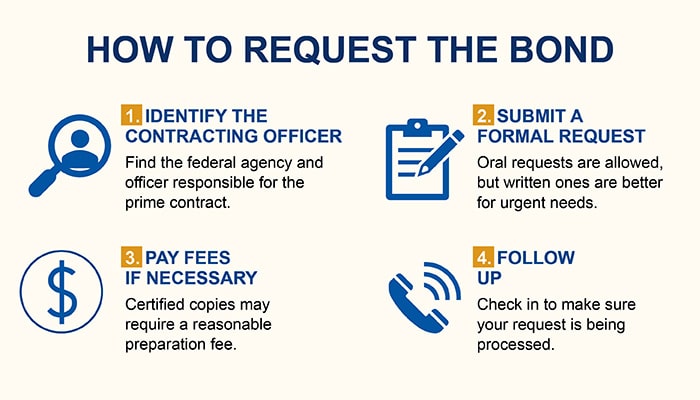
How to Request the Bond
- Identify the Contracting Officer. Find out which federal agency awarded the contract and the name of the contracting officer. If you didn’t receive this information when you signed your subcontract or obtained a purchase order, check the Federal Procurement Data System or SAM.gov.
- Submit a Formal Request. Oral requests are now specifically permitted, but a written request may be more appropriate, and likely to receive a prompt response.
- Pay Fees if Necessary. If you need a certified copy of the bond, then pay the reasonable costs of preparation as determined by the agency.
- Follow Up. Follow up to ensure your request is processed.
With the recent changes to the FAR, the federal government has made it easier for subcontractors and suppliers to protect themselves. If you are a valued customer and have questions about our experience with Miller Act claims or navigating the bond process, don’t hesitate to contact us.