Covering Tough Ground: Water Pressure Tips for Hydro Excavation
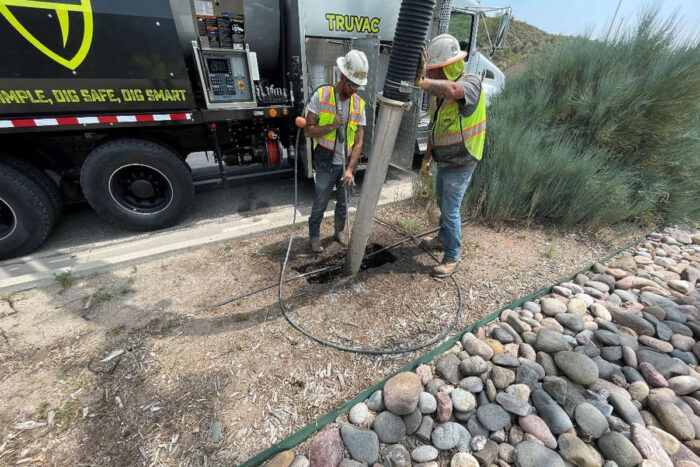
When used properly, hydro excavation gives crews a precise, non-destructive way to uncover underground infrastructure, using pressurized water to break up soil and a powerful vacuum to remove the resulting slurry. But when it comes to water pressure, more isn’t always better.
The right pressure depends on the ground, the jobsite, the nozzle and, most importantly, what may be buried below. Understanding those variables can help operators work efficiently while reducing the risk of damaging underground utilities.
Here are five factors to consider when managing water pressure on a hydro excavation job.
1. Start With the Ground
Before setting the water pressure, consider what you’re asking the water to do.
Loose or sandy soil may require less pressure to break apart than dense, compacted material. Moisture content, rocks and other obstructions can also affect how readily the ground can be excavated. Frozen ground presents another challenge and may require heated water to help penetrate and loosen the soil.
That makes site assessment an important first step. TRUVAC recommends considering factors such as soil density, moisture content, rocks and excavation depth when determining appropriate pressure. Crews should also consider what underground utilities are being uncovered to make sure they do not damage those with too much pressure.
The objective isn’t to use as much pressure as possible. It’s to use the appropriate pressure for the conditions and the work being performed.
2. Match the Pressure to the Setting
An industrial excavation and a utility located in a residential backyard can present very different conditions.
On an industrial site, crews may be working through heavily compacted ground or tackling larger-volume excavation. In a residential setting, operators may be daylighting gas, electric, fiber or water lines in a confined area where precision is paramount.
Even within the same project, conditions can change as the excavation progresses. Operators should continually account for the material being excavated, the proximity of underground facilities and applicable jobsite requirements rather than relying on one pressure setting for every situation.
Before excavation begins, crews should also call 811, review available utility information and follow applicable regulations, utility-owner requirements and site procedures.
3. Know Your Nozzle
Pressure alone doesn’t tell the whole story. The way that pressure is delivered matters.
Straight-tip nozzles concentrate the water stream in one location, while rotating or spinning nozzles distribute that energy over a wider area. Research presented by the Gas Technology Institute (GTI) demonstrates how significant that distinction can be.
In GTI testing, a straight water jet operating at 1,500 psi punctured medium-density polyethylene (MDPE) pipe after three seconds when held eight inches above the pipe. At greater distances, puncture still occurred when the jet remained in place longer.
Spinning nozzles produced markedly different results. Tests of spinning nozzles operating at 2,500 psi found no failure of MDPE pipe after five minutes, including tests conducted just one inch above the pipe.
The takeaway isn’t that one pressure number is right for every application. It’s that nozzle type, pressure, distance and technique work together. Operators should understand the characteristics of the nozzle they’re using and follow applicable standards and requirements.
4. Keep It Moving
Technique matters just as much as equipment settings.
GTI-cited best practices state that pressurized water or air wands should never remain motionless during excavation and recommend maintaining eight inches between the nozzle and the underground facility or subsoil.
The straight-jet testing helps illustrate why. Concentrating pressurized water on one point for even a few seconds can significantly increase the potential for damage.
A TRUVAC safe-digging guide also advises operators to avoid aiming directly at underground facilities and not to insert the nozzle into the subsoil while excavating within the tolerance zone.
Good hydro excavation technique, therefore, is about more than dialing in a PSI number. It means controlling pressure, distance, nozzle movement and direction throughout the excavation.
5. Take the Guesswork Out of Pressure Control
Conditions can change quickly on a jobsite. Technology can help operators respond without losing control of one of the most important variables.
TRUVAC’s patented DigRight technology, available on the Paradigm, FLXX and HXX, allows operators to select a maximum water-pressure limit based on site or industry requirements. Coupled with TRUVAC’s Multi-flow water pump, the system automatically adjusts water flow to match the operator’s nozzle selection.
Three programmable presets also allow operators to transition quickly between pressure ranges, which can be particularly useful when the work or conditions change. DigRight continuously monitors the user-defined pressure limit while automatically adjusting the water pump.
The system can also reduce unnecessary wear on check, unloader and relief valves by avoiding water bypass, while eliminating wasted energy can help reduce fuel consumption.
Pressure With a Purpose
Hydro excavation is designed to provide crews with greater precision around underground infrastructure. Getting the most from it means treating water pressure as a tool rather than just a number on a gauge.
Read the ground. Understand the setting. Choose the appropriate nozzle. Keep the wand moving. And use pressure-control technology when available to help operators stay within the requirements of the job.
Because when tough ground meets sensitive infrastructure, the goal isn’t maximum pressure. It’s the right pressure for the job.
To learn more about TRUVAC hydro excavators and DigRight technology, visit TRUVAC.com. Tags: Truvac