A Cut Above: Increasing Efficiency in Fiber Installation
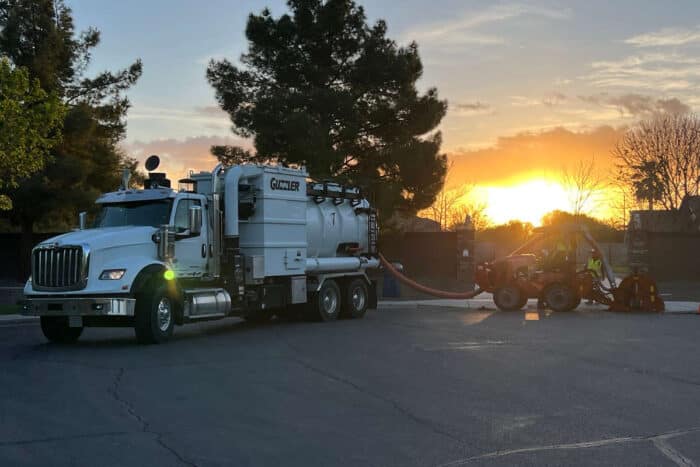
Tips from the Guzzler Team
As fiber demand accelerates across urban, suburban and rural markets, contractors are under increasing pressure to install more footage per day without sacrificing quality, safety or margins. Microtrenching has emerged as a preferred method for fiber deployment due to its speed and minimal surface disruption, but like any process, efficiency depends on execution.
From equipment selection to workflow optimization, here are key strategies the Guzzler team recommends for improving productivity on fiber installation projects.
1. Start with a Clean, Consistent Cut
Efficiency begins at the trench. Inconsistent cuts or incomplete debris removal can slow production, require rework and impact final installation quality.
The goal is simple: cut once, clean once.
Ensuring trenches are fully cleared on the first pass reduces the need for repeat work and keeps crews moving forward instead of doubling back. High-performance vacuum systems play a critical role here, removing debris completely and maintaining a clean channel for fiber placement.
Matching the vacuum system to the material and application is essential to achieving optimal results and avoiding inefficiencies tied to improper equipment selection.
2. Minimize Stop-and-Go Workflow
One of the biggest inefficiencies in fiber installation is interruption: starting, stopping and repositioning equipment throughout the job.
Continuous operation is significantly more efficient than interrupted workflows.
Technologies such as creep drive on the Guzzler MT, where the vacuum system operates while the vehicle moves, allow crews to trench and clean simultaneously. This eliminates redundant steps and keeps production linear rather than fragmented.
The result: fewer pauses, smoother operation and more footage completed per shift.
3. Reduce Dump Cycles
Material handling is often overlooked as a productivity factor, but frequent dumping can quickly erode efficiency.
Every trip to a dump site introduces downtime, fuel costs and logistical complexity, especially in urban or congested environments.
Selecting equipment with sufficient debris capacity allows crews to work longer without interruption. In real-world applications, reducing dump frequency from multiple trips per day to just one or two can dramatically improve daily output and job profitability.
In addition, fewer dump trips help crews stay focused on installation rather than transport logistics, improving both speed and consistency.
4. Optimize Crew Size and Roles
Labor efficiency is just as important as equipment efficiency.
Modern fiber installation increasingly relies on smaller, highly coordinated crews supported by advanced equipment. Features such as integrated camera systems and improved operator visibility can reduce the need for additional spotters while maintaining safety and precision. This not only lowers labor costs but also simplifies coordination on the jobsite, particularly in tight or high-traffic areas.
5. Plan Around Environment and Access
No two job sites are identical, and efficiency often hinges on how well crews adapt to conditions.
Urban streets, residential neighborhoods and high-traffic corridors all present unique challenges. Tight access points, noise considerations and time-of-day restrictions can all impact productivity.
Planning for these variables, whether that means early start times, quieter equipment or compact machine footprints, helps crews maintain momentum without disruptions.
Efficient operations are not just about speed; they’re about maintaining steady progress under real-world conditions.
6. Leverage Purpose-Built Microtrenching Equipment
While general-purpose vacuum systems can support a range of applications, efficient fiber installation benefits from equipment specifically engineered for microtrenching.
The Guzzler MT, for example, is designed to streamline fiber installation by combining high airflow performance with features that support continuous operation and cleaner trenches. Its ability to remove debris efficiently and keep pace with cutting operations enables crews to install more linear feet per day while reducing rework.
In practice, purpose-built microtrenching units help contractors achieve faster operating speeds, cleaner results and improved overall productivity — key advantages in today’s competitive fiber market.
7. Focus on First-Time Quality
Finally, efficiency hinges heavily on speed, which requires getting it right the first time.
Clean trenches, proper depth and minimal surface disruption all contribute to faster project completion and fewer callbacks. When crews can rely on their equipment and processes to deliver consistent results, they spend less time correcting issues and more time getting the job done.
The Bottom Line
As fiber networks continue to expand, contractors who prioritize efficiency will be best positioned to scale operations and remain competitive. By focusing on clean execution, continuous workflows, reduced downtime and purpose-built equipment, crews can significantly increase daily production without compromising quality or safety.
In fiber installation, efficiency is more than a competitive advantage — it’s a requirement.
Find more information on the Guzzler MT at Guzzler.com. Tags: Guzzler