Top Jobs (Sanitary Sewer Collection Category): James River Crossing
[Editor’s Note: NUCA‘s Top Job Project award recognizes challenging, innovative, or unique projects completed with excellent results. These projects represent the best of the best and these jobs illustrate the highest quality of work our industry has to offer. Six construction job categories are eligible for submission.]
The Boat Harbor Treatment Plant Conversion projects are part of Hampton Roads Sanitation District (HRSD)’s ongoing Sustainable Water Initiative for Tomorrow (SWIFT) program, a major regional effort focused on groundwater sustainability, environmental resilience, and long-term water supply security. A key component of the SWIFT program is the James River Crossing (JRX).
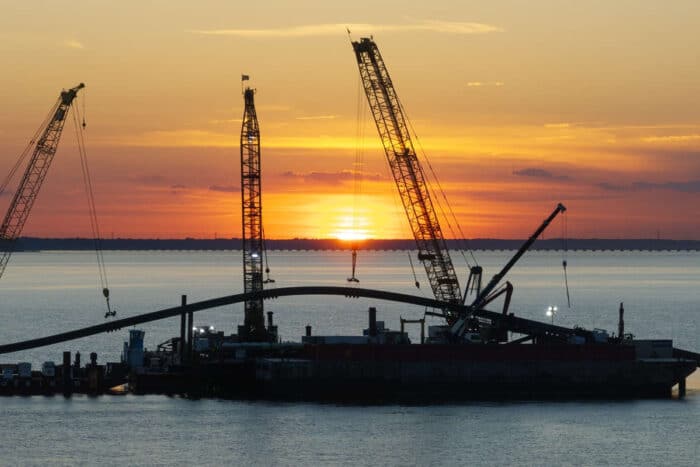
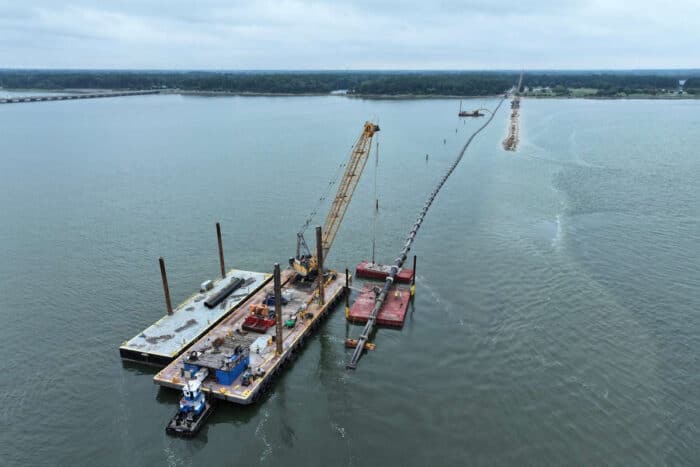
Section 1 of this subaqueous force main project, delivered using a fixed-price design-build method, was awarded to a team led by Garney in April 2022, with construction beginning in July 2023. The scope included installation of a raw wastewater force main across the James River using a buried subaqueous installation method. The total crossing exceeds four miles and consists of new HDPE pipe ranging from 42- to 54-in. in diameter, including a world record–breaking horizontal directional drill utilizing large-diameter HDPE pipe. Section 2 is a land portion that includes more than one mile of 48-in. HDPE pipe installed by open-cut methods, extending the force main from the river to the treatment plant.
Challenges
The project faced significant technical and constructability challenges, including extending the HDD alignment from a planned water-to-water drill to the shoreline, managing excessive pull forces over an unprecedented drill length, and installing large-diameter HDPE pipe at depths exceeding 170 ft below the river.
The extreme depth imposed substantial external loads on the pipe, creating risks of deflection, buckling, and overstressing due to tension. In addition, the required pipe diameter and dimension ratio were relatively new to the U.S. market, increasing material performance and quality risks.
Innovative Solutions
The design-build team collaboratively extended the HDD by more than 2,500 lf, converting it to a land-to-water HDD and increasing the total length to more than 5,700 lf. The change saved HRSD more than $10 million.
To mitigate pull-force risks, the team deployed a custom pipe pusher manufactured in Germany—the only unit of its kind currently operating in the United States—capable of applying up to 250,000 lbs of compressive force to reduce tensile loads.
HDPE was selected for its corrosion resistance and thick wall. To address extreme external pressures, the team sourced 42-in. DR-11 IPS pipe with 3% initial ovality, exceeding industry standards. Direct engagement with the manufacturer and on-site QA/QC verification helped ensure material performance and constructability.
Project Benefits
The project’s challenges and innovative solutions delivered value before and during construction by reducing risk, improving constructability, and providing significant cost and schedule advantages.
During procurement and early design, the design-build team evaluated constructability challenges, including HDD length limitations, pull-force risks, and pipe performance at extreme depths.
Converting the HDD geometry to the shoreline eliminated the need for additional marine work, simplified permitting, and reduced environmental impacts. Early identification of material and installation risks led to the selection of HDPE and the development of a pull-force mitigation strategy, resulting in more than $10 million in cost savings and increased confidence in the project’s technical feasibility.
Innovative construction solutions directly addressed execution risks. The custom pipe pusher reduced tensile stresses on the HDPE during installation, enabling successful completion of the record-breaking HDD length.
Tight control of pipe ovality and rigorous QA/QC procedures ensured the pipe could withstand extreme external loads at depths exceeding 170 ft. These innovations minimized the likelihood of installation failure, reduced rework, and maintained schedule certainty while delivering a durable, long-term asset for the owner.
Together, early risk mitigation and specialized construction methods transformed complex challenges into measurable performance, safety, and cost benefits.
“We are very satisfied with the efforts completed by the Garney project team (on the James River Crossing projects),” said Bruce Husselbee, HRSD Chief Engineer. “Some of the notable accomplishments for these projects include the project teams’ ability to cut overall project costs with an innovative concept for a world-record horizontal directional drill under the port channel in the James River, remaining flexible with changes that improve the outcome of the project, and finding win-win solutions when unforeseen field conditions are encountered. No project goes perfectly, particularly when you are retrofitting a large wastewater treatment plant, but the Garney project team has worked collaboratively with HRSD to find solutions and not to point blame or find excuses.”
Building a Sustainable Future
SWIFT was developed to address interconnected environmental, resource, and regulatory challenges facing eastern Virginia and the Hampton Roads region. The program provides an integrated approach to groundwater sustainability, coastal resilience, water-quality protection, and long-term water supply security.
For decades, groundwater withdrawals from the Potomac Aquifer have exceeded natural recharge, resulting in declining water levels and increasing the risk of aquifer depletion. Excessive pumping has also contributed to land subsidence, which worsens vulnerability to sea level rise and flooding in the low-lying Hampton Roads region.
Declining aquifer levels further increase the risk of saltwater intrusion, threatening freshwater supplies and water quality. SWIFT helps counter these impacts by recharging the aquifer and maintaining a healthier freshwater balance.
In addition to addressing groundwater challenges, SWIFT supports environmental protection and regulatory compliance by reducing the discharge of treated wastewater into regional rivers such as the James, Elizabeth, and York. By reusing highly treated water instead of releasing it, the program reduces nutrient loads to the Chesapeake Bay and supports ongoing ecosystem restoration efforts.
Collectively, SWIFT strengthens public health protections, improves environmental resilience, and provides a sustainable, reliable water supply for future generations.
[For more information about NUCA’s Top Jobs program, visit https://nucadigs.com/awards]
Project at a Glance
- Project: James River Crossing
- Location: Newport News, VA
- Category: Sanitary Sewer Collection
- Contractor: Garney
- Owner: Hampton Roads Sanitary District