Link-Belt Excavators: Technology, Uptime and the Human Touch
Q&A with Wyatt Skaggs, Product Manager, Link-Belt Excavators
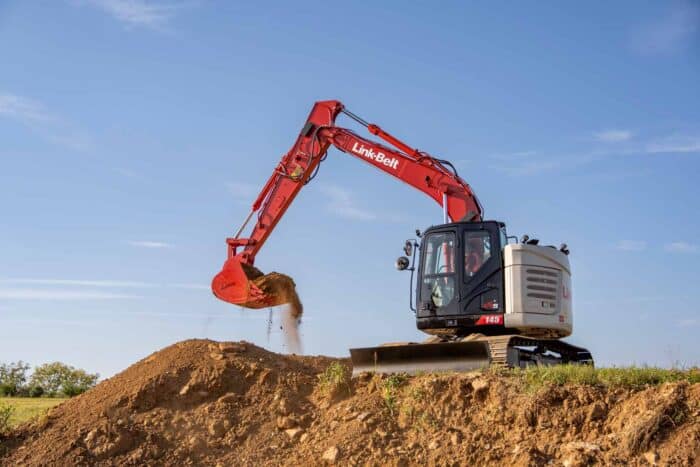
Link-Belt Excavators has long been known as a premium player in the earthmoving market, but the company is leaning hard into technology to help contractors work safer, smarter and with fewer people on the job. From minimal swing excavators tailored to tight utility corridors to factory-integrated assist systems designed to boost both seasoned operators and new recruits, the Lexington, Kentucky-based manufacturer is positioning its lineup for the next decade of infrastructure work.
Utility Contractor spoke with Wyatt Skaggs, product manager and leader of Link-Belt’s emerging tech team, about the company’s excavator range, new X4S models, and how technology and support are helping contractors tackle labor shortages, regulations and cost pressures.
Q: For readers who may not know Link-Belt Excavators, can you give a brief overview and what makes your machines unique?
Skaggs: Were headquartered here in Lexington, Kentucky, and we develop, market and support excavators, material handlers, forestry machines and, increasingly, technology solutions like grade control and onboard assist features.
What really sets Link-Belt Excavators apart is the human side of the business. A lot of OEMs build good iron, but we pride ourselves on how we support the machines and the people who run them. When our field teams sell or support a machine, they stay emotionally attached to that machine’s success – that culture of “building stronger communities” is something we genuinely live inside these walls.
Q: What does the Link-Belt excavator lineup look like in terms of size range and key markets?
Skaggs: On the full range, we go from roughly 7- and 8-ton machines — our 75 and 80 models — up to about 75 tons on the heavy end. Within that, we offer four minimal swing radius (MSR) machines, which are a big focus for utility work: the 75, the new 145 X4S, the 245 (with a 245 X4S on the way), and the 355, which is about a 35-ton machine.
Those MSR machines are designed to swing within the tracks, which is ideal in municipalities and tight urban jobsites where you need to dig deep but cannot take up a lot of space or hang the counterweight into traffic. Beyond utility, our models serve general construction and even some forestry work.
Q: How is technology changing the way contractors operate, and what are you building into the lineup?
Skaggs: Going back 10 to 15 years or so, technology was viewed as a bell-and-whistle — nice to have, but not essential. More recently, particularly post‑COVID, it has shifted into a productivity tool. Features like height/depth alarm, payload and digital level are now being used every day to hit specs faster and safer instead of just being options on a price sheet.
On the new 145 X4S, for example, you can get a height/depth alarm to set a limit relative to a power line above you or a utility line below you, so you know exactly when you’re getting close to that boundary. The digital level allows operators to see what kind of grade they’re cutting with the blade and whether the machine is sitting on a level base, which improves both safety and final quality.
Payload and our Payload Assist application are especially valuable when you’re moving material—if a contractor needs to move 100 tons in a day, they can track it from the seat and know how close they are to the target. We also partner with Trimble on precision grade control systems, and we’re seeing those paired with tilt and tilt-rotator buckets for fine grading and complex site work.
Dynamic Stability Assist is another newer feature on the X4S series for the 220 and 370, and it’s one of my favorites. It doesn’t limit what you can lift, but it manages the lift pattern to keep the machine more stable and reduce rocking, which cuts operator fatigue and machine wear over time.
Q: You mentioned the 145 X4S, which recently debuted. What’s unique about that model, especially for utility contractors?
Skaggs: The 145 X4S is a core model for us and a huge part of our business; dealers really view it as a benchmark Link-Belt machine. It’s a minimal swing radius design that fits well in streets, subdivisions and tight jobsites, but it still has the power and reach to cross over between utility, general construction and even some forestry work.
What makes the 145 X4S stand out is the combination of fuel efficiency, build quality and technology options. We’re known as a premium product brand, and the 145 embodies that, backed by our five‑year, 5,000‑hour warranty, which is a big differentiator. From a product management standpoint, the lack of negative feedback is a strong indicator of success; in our field, a silent user base often signals a seamless, reliable experience.
Q: Safety is always a priority. How are Link-Belt excavators evolving to help minimize incidents and accidents?
Skaggs: We’ve bundled our safety- and awareness-focused systems under what we call work site assistant tools. A key piece of that is our WAVES camera system, which is now standard on all X4S machines.
On non‑MSR X4S machines, WAVES provides a 270‑degree view from three cameras—one on the counterweight, one on the left side and one on the right side—stitched on the in‑cab monitor. On MSR machines, the coverage is 230 degrees, still providing strong visibility where it matters most in tight working envelopes.
We also offer a WAVES+ system with audible alarms, which many customers in more highly regulated markets like California and Oregon are opting for, especially when they’re bidding government work that specifies enhanced detection or awareness systems. Combine that with the height/depth alarm and digital level, and you have multiple layers of technology aimed at preventing contact with overhead/underground utilities and maintaining a stable working platform.
Q: With so many models on the market, what advice do you have for a contractor shopping for a new excavator?
Skaggs: I always start with the tool: what are you trying to do and what are you hanging on the end of the stick? Are you running a mower, a standard bucket, a tilt bucket, a tilt rotator? Once you know the job and the attachment, then you size the machine around that.
Next, think transportation. How are you getting the machine to the job? Do you already have a tag trailer that can handle 70,000 pounds, or are you hauling on the back of a dually pickup? That determines the weight class that makes sense and keeps you compliant and efficient.
Then I’d look hard at warranty and total cost of ownership, because that goes straight to a contractor’s pocketbook. Our five‑year, 5,000‑hour warranty is a big differentiator versus typical one‑year coverage. Once you’ve settled those fundamentals, picking between specific models is more about tailoring the machine to immediate and future jobs.
Q: What are your top tips for keeping excavators operating at peak proficiency and maximizing uptime?
Skaggs: First, I’d say buy a machine with a strong warranty, because that’s your safety net if something unforeseen happens. Beyond that, staying on top of required maintenance — especially oil sampling — is critical, not just to keep the warranty valid but to catch issues early. For us, that means oil samples every 500 hours as a standard practice.
Features like Dynamic Stability Assist on the 220 and 370 X4S also contribute to longevity by reducing rocking and shock loads on the structure and components. Less jarring for the operator generally translates into less stress on the machine over thousands of cycles, which shows up as lower maintenance and longer service life.
Q: Contractors face many pressures, including carbon reduction targets, labor shortages, fuel costs and evolving regulations. What issues are you seeing most, and how can manufacturers help?
Skaggs: The two big issues I see are labor and the broader business environment — interest rates, tariffs and regulations. On labor, technology is the brace that helps contractors do more with fewer people. For seasoned operators, assist systems and grade control can multiply their efficiency; if you can make a veteran 20 percent more productive, that goes a long way toward covering what a less efficient new hire might have done.
For younger workers — people say under 30 — technology is also a recruiting tool. They’re used to high‑tech vehicles, smartphones and screens; stepping into a cab with no tech can feel foreign. When the excavator has modern displays, guidance and assist features, it feels familiar and lowers the barrier to learning. Tags: Link-Belt Excavators