Milwaukee Tool: A Century of Innovation Driving the Future of Utility Construction
For more than a century, Milwaukee Tool has been a trusted name on jobsites across the construction industry, known for its relentless commitment to innovation, durability, and user‑driven design. From its founding in 1924 to today’s advanced cordless systems, the company has continually redefined what professional tradespeople expect from their tools—whether in performance, safety, or reliability.
Now celebrating over 100 years of success, Milwaukee continues to lead the way with solutions built around real‑world challenges. Its deep engagement with users—from utility contractors to industrial trades—has fueled generations of product breakthroughs that improve jobsite productivity and safety.
In the following interview, Milwaukee Tool representatives discuss the driving forces behind the company’s enduring success, the evolution of its cordless platforms, and how its products are meeting the daily demands of underground utility construction.
1. Just a quick introduction, tells us a bit about Milwaukee Tool. What is unique about the company and its products that have allowed it to be successful for over 100 years? What are the most popular tools in general, historically and currently?
Founded in 1924, Milwaukee Tool has led the industry in developing innovative, durable solutions that improve safety and productivity on the jobsite. Milwaukee® works directly alongside end users to understand the evolving demands of their work and identify opportunities for meaningful improvement. By evaluating real‑world challenges, frustrations, needs, and past limitations, Milwaukee can rethink solutions from the ground up and deliver the game‑changing innovation seen across our product lines.
2. Specifically for utility construction, primarily open-cut sewer and water main projects that NUCA members work on, which Milwaukee tools do you see on almost every crew truck? Why have they become “must haves” for utility contractors?
While exact tool lists vary by job, most utility crews tend to prioritize high‑power, heavy‑duty cordless tools that can handle demanding applications. Milwaukee Tool’s M18™ and MX FUEL™ platforms are especially well‑suited for utility construction, supporting core tasks like cutting, drilling, and compaction.
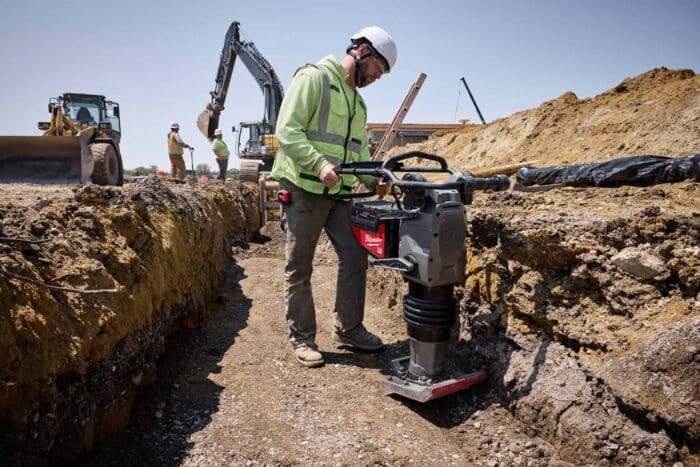
High-torque impact wrenches paired with Milwaukee’s SHOCKWAVE™ Impact Duty Sockets are essential for daily tasks. Cutoff saws and band saws handle pipe cutting effectively, while MX FUEL™ compaction equipment, such as the MX FUEL™ Rammer, helps crews tackle compaction and site prep without relying on gas-powered equipment.
For contractors installing gas lines, an essential solution is the MX FUEL™ Electrofusion Processor, delivering cordless fusion capability without the need for generators or extension cords. Designed for portability and fast setup, the system simplifies the fusion process while providing reliable performance and all-day runtime on the MX FUEL™ battery platform to increase productivity.
Beyond power equipment, Milwaukee hand tools, such as pipe wrenches and adjustable wrenches, are everyday staples for utility crews. Just as important, jobsite personal protective equipment (PPE), including gloves, safety glasses, and the BOLT™ Front Brim Safety Helmet with IMPACT ARMOR™ Liner (Type 2, Class E), which provides advanced slip, trip, and fall protection, helps crews stay protected while maintaining productivity. Having these solutions designed with trade-specific durability in mind ensures they stand up to harsh underground and open-cut environments.
The result is a fully integrated system on the crew truck, from equipment and cordless power tools to hand tools, accessories, and PPE. That system approach delivers fewer compatibility issues, improved efficiency, and solutions engineered specifically for the realities of utility work.
3. How have these tools evolved? (Corded vs. cordless; Battery improvements; design, manufacturing, distribution; etc.)
The evolution of cordless tools has been driven by significant advancements in both motor design and intelligent electronics. Milwaukee’s POWERSTATE™ Brushless Motor is purpose‑built to deliver the high, sustained power required for demanding jobsite applications, while REDLINK PLUS™ Intelligence serves as the system’s control center, managing how that power is delivered and protected.
Through continuous communication between the tool and battery, REDLINK PLUS™ Intelligence monitors performance in real time. This system‑level control allows tools to maintain consistent output under heavy load, helping ensure reliable performance in demanding jobsite conditions.
4. How are contractors using your cordless platforms (M18, M12, MX FUEL) specifically in utility environments where access, power, and safety are big concerns?
Utility contractors are increasingly relying on cordless platforms to overcome common jobsite challenges such as limited access, lack of power, and heightened safety requirements. In underground and confined-space environments, cordless solutions eliminate the need for generators and extension cords, reducing trip hazards and improving overall site safety.
Battery-powered equipment also allows crews to work without being exposed to emissions, especially in tight work areas. For example, cordless cutoff saws enable work in these confined spaces without introducing exhaust fumes, while still delivering the performance required for cutting concrete or access panels. Overall, cordless solutions help streamline setup, improve mobility, and allow crews to work more safely and efficiently across a wide range of utility applications
5. Utility work is hard on equipment: mud, water, cold, vibration. What design features/technologies has Milwaukee built into its tools to make them more durable and reliable in sewer and water main applications?
Utility jobsites demand equipment that can withstand challenging conditions, including exposure to mud, water, cold temperatures, and continuous vibration. Milwaukee’s solutions are designed specifically for field use, with built-in protective measures that help prevent water intrusion and allow moisture to exit the tool if exposure occurs.
Battery technology is also engineered to perform across a wide temperature range, supporting reliable operation in both cold and hot environments. While tools are not designed to be fully waterproof, they are built to be water-resistant and durable enough to handle real-world jobsite conditions. In addition, vibration-reduction features help improve user comfort and reduce fatigue during prolonged use.
6. Purchasing tips – what should a contractor considering when buying a tool or determining which tool to buy?
When contractors are selecting tools, they should look beyond immediate needs and evaluate the bigger picture. Working with a full solutions provider, rather than purchasing standalone tools, can help ensure compatibility across power tools, equipment, accessories, hand tools, storage, and safety gear, creating a more streamlined and efficient system on the jobsite.
Platform compatibility is also critical; investing in systems that offer forward and backward compatibility allows crews to expand their lineup over time without replacing batteries or chargers. Choosing a platform that has remained consistent for many years helps protect that investment as new tools are introduced, making system scalability, long-term usability, and overall fleet standardization key decision factors for utility contractors.
7. How are the tools designed to help keep workers safe?
Rather than focusing on individual products, safety is best addressed through integrated tool features designed to protect the user. Anti-vibration technology helps reduce strain during extended use, while Milwaukee’s AUTOSTOP™ features prevent injuries when tools bind or encounter resistance.
These built-in safeguards, found across drills, saws, and other high-use tools are designed to reduce risk without relying on user intervention. For utility crews working in demanding environments, embedded safety features play a critical role in improving jobsite safety and consistency.
8. What steps can contractors take to help ensure they get the longest life from their tools?
Maximizing tool life starts with choosing equipment designed around real-world usage. Milwaukee’s product development process relies heavily on extensive field research, with teams working directly alongside professional users to understand how tools are actually used on the job.
This feedback-driven approach ensures solutions are built to withstand the conditions utility crews face daily. Proper maintenance and correct application matter, but long-term durability is ultimately tied to tools being designed from the start with user input and jobsite realities in mind.
9. What is something that people may not know about Milwaukee Tool or its products?
One of the most overlooked aspects of Milwaukee Tool’s innovation process is that many product breakthroughs originate directly from user feedback. Rather than developing tools in isolation, product teams spend significant time in the field observing how contractors work and identifying opportunities to improve productivity and safety. In many cases, the professional user plays a direct role in shaping the final product. This deep level of field engagement is a key driver behind Milwaukee’s continued innovation.
10. Looking ahead, what trends do you see shaping the next generation of Milwaukee tools for underground utility construction—whether that’s higher power cordless equipment, smarter diagnostics, or more specialized sewer/water solutions?
Several trends are already shaping the next generation of Milwaukee solutions for underground utility construction. Increased focus on safety features, productivity gains, and runtime improvements continue to guide development.
Advancements in battery technology and smart features, such as integrated electronics and platform connectivity, also play an increasing role. Milwaukee’s ONE‑KEY™ technology, for example, provides tangible benefits for maintenance, asset management, and overall fleet visibility. Milwaukee’s commitment to innovation, safety, and trade‑focused design remains central to future product direction. Tags: Milwaukee Tool